Tampa Bay’s real estate market is booming, and Tampa Bay investment properties are attracting serious investors nationwide. The region combines strong population growth, job diversity, and prices that still offer real upside potential.
At Kearns Mortgage Team, we’ve watched this market transform. This guide walks you through proven strategies to capitalize on what Tampa Bay offers right now.
Why Tampa Bay Stands Out for Real Estate Investors
Tampa Bay attracts investors for three concrete reasons: people move here in significant numbers, the job market keeps expanding, and property prices remain reasonable compared to other Florida hotspots. Between 2021 and 2026, Tampa Bay has seen consistent migration from high-tax states, with families and professionals seeking affordability without sacrificing opportunity. The Tampa Bay Economic Development Council logged 29 closed business projects in the latest year, creating over 2,200 jobs and generating more than $273 million in capital investment. This isn’t theoretical growth-it’s measurable economic activity that translates directly into rental demand and property appreciation. The startup ecosystem proves particularly active, with Embarc Collective reporting 40% more applications in 2025 compared to 2024, and roughly 1,200 high-skilled jobs created over five years across the entrepreneurial sector. Corporate relocations from major brands like Wagamama and Orion Edge signal a durable business climate that supports long-term tenant stability for rental properties.
Property Values Still Offer Real Upside
South Tampa neighborhoods like Bayshore Beautiful, Palma Ceia, and Davis Islands show median sale prices around $322,000, up 22% since 2021. University Square in North Tampa proves even more compelling for value-focused investors, with median prices at $299,000 but appreciation of 45.9% over the same period, combined with average rents around $1,558. Hyde Park demonstrates premium appreciation at 34.7% since 2021, with median sales reaching $835,000 and robust rents near $2,614. Ybor City, designated a National Historic Landmark District (National Park Service), posted 37.4% appreciation to a current median of $285,000, attracting renters with its nightlife and cultural draw at roughly $1,855 monthly rent. Even emerging areas like Highland Pines show momentum, with median prices climbing 44.9% to $282,500 despite past reputation challenges.
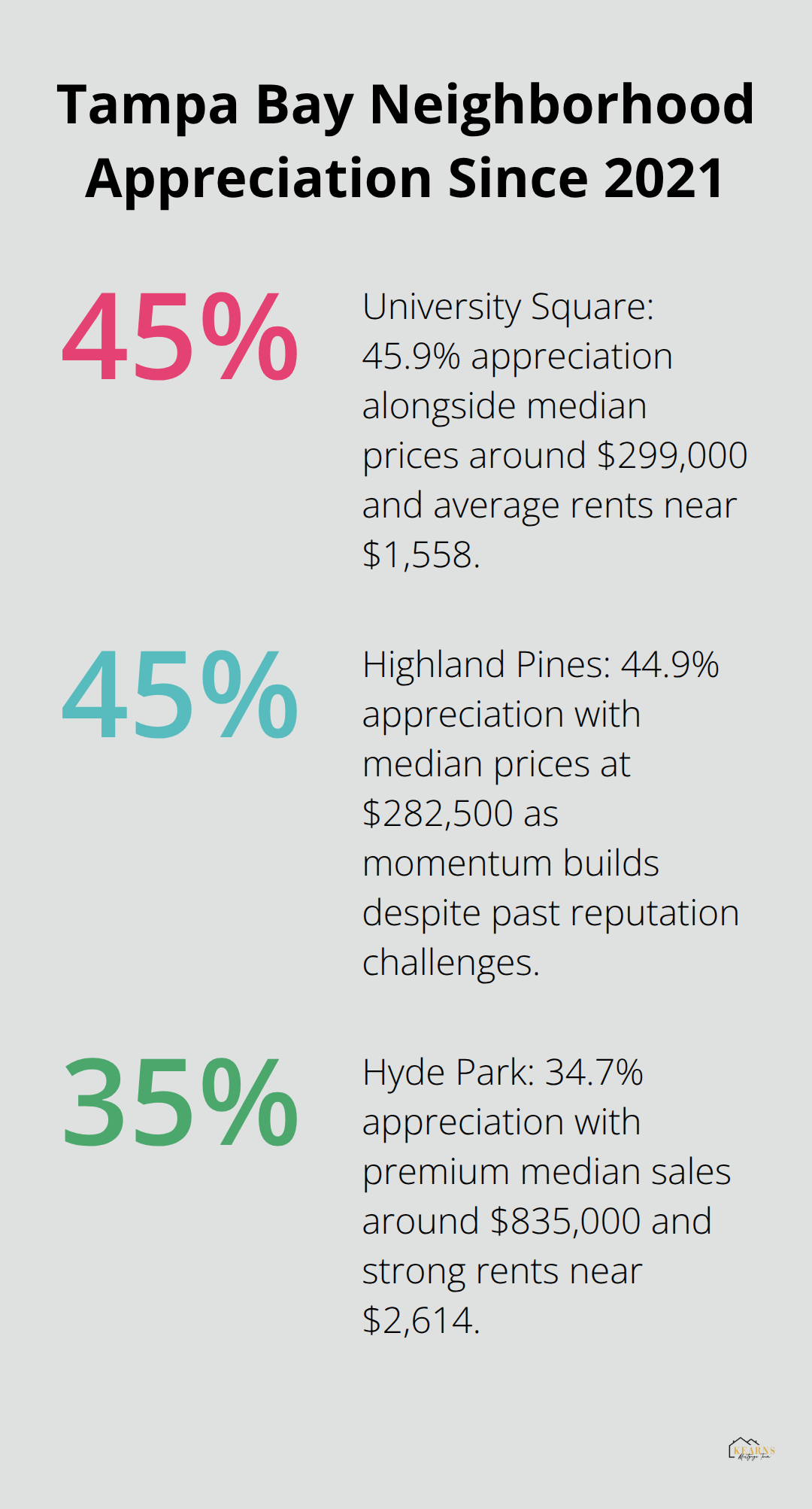
Tampa’s stabilizing prices create genuine investment opportunities, especially compared to saturated markets in South Florida where median prices have stabilized or declined.
Rental Income Potential Across Multiple Demographics
Young professionals and service members anchor stable rental demand. South Tampa near MacDill Air Force Base supports reliable tenant pools, with housing stipends driving consistent rents around $1,678 for one-bedroom units and $2,948 for three-bedroom homes. Channel District commands premium nightly rates for short-term rentals at median $3,198 monthly, supported by waterfront views and proximity to downtown attractions like the Florida Aquarium and Amalie Arena. Family-focused neighborhoods with solid schools attract long-term tenants seeking affordability, while urban districts near Water Street and Midtown draw mixed-use seekers willing to pay for walkability. The diversity of tenant profiles means you’re not betting on a single demographic-investors can target different neighborhoods based on their cash flow strategy. Each home sale in Tampa Bay generates roughly $75,000 in local economic activity, creating a multiplier effect that sustains both employment and housing demand across price points.
What This Means for Your Investment Strategy
The combination of job creation, population growth, and diverse rental demand creates multiple pathways to profitability. You can pursue long-term rentals in family-friendly areas, short-term rentals in urban or coastal pockets, or fix-and-flip projects in transitional neighborhoods. The key is matching your capital and risk tolerance to neighborhoods where fundamentals align with your strategy. Understanding which neighborhoods fit your goals requires more than broad market statistics-it demands local insight into micro-market dynamics, zoning rules, and emerging development patterns. That’s where neighborhood-specific research and local expertise become your competitive advantage.
Choosing Your Tampa Bay Investment Path
Appreciation Plays in Emerging Neighborhoods
University Square in North Tampa exemplifies the appreciation strategy: median prices sit at $299,000 with 45.9% growth since 2021, while average rents around $1,558 create immediate cash flow as the area develops further. Ybor City, now a National Historic Landmark District, climbed 37.4% to $285,000 and attracts renters at roughly $1,855 monthly, proving that cultural revitalization translates to tenant demand and equity gains. Highland Pines presents a higher-risk entry at $282,500 median (up 44.9%), where early investors benefit from neighborhood improvements and school expansions. Most investors chase appreciation without verifying local catalysts-new transit corridors, commercial development, or school improvements must precede your purchase, not follow it. Research what’s actually under construction or approved through the City of Tampa’s planning documents before committing capital to transitional areas.
Cash Flow Rentals in Established Zones
Short-term rental properties in established urban and coastal zones generate superior cash flow compared to appreciation-focused buys. Channel District commands $3,198 monthly for waterfront units near downtown amenities like the Florida Aquarium and Amalie Arena, while South Tampa near MacDill Air Force Base delivers stable $1,678 one-bedroom rents from service members with housing stipends. Professional management handles dynamic pricing, guest screening, and maintenance responsiveness-costs that often justify themselves through 15–25% higher occupancy rates and nightly rates that exceed long-term equivalents. Verify municipal short-term rental rules before purchase, as some Tampa Bay cities restrict or ban them entirely.
Fix-and-Flip Execution in Redevelopment Areas
Fix-and-flip opportunities exist in neighborhoods showing early signs of redevelopment, particularly where builders replace older homes with new $3–5 million properties. You’re not betting on neighborhood transformation alone; you execute on existing momentum. Focus on concrete-block elevated homes over older ground-level wooden construction, as these command higher resale values and lower insurance costs. Redevelopment accelerates when new construction attracts higher-income buyers, which raises demand for upgraded amenities, restaurants, and entertainment-this positive spiral creates your exit window.
Matching Strategy to Your Capital and Timeline
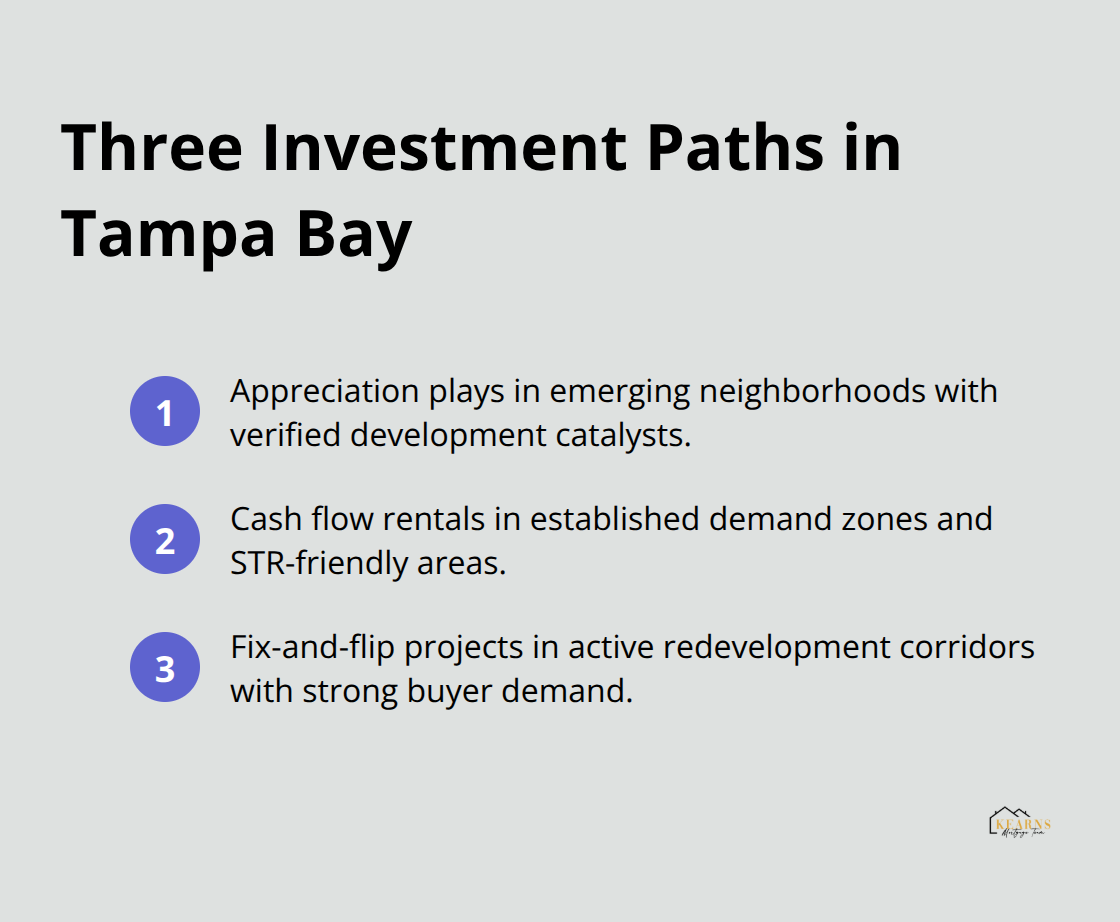
Three distinct paths exist: appreciation plays in emerging neighborhoods, cash flow rentals in established demand zones, and fix-and-flip projects where redevelopment is already underway. Your capital deployment depends on which timeline and risk profile matches your situation. Investors with longer horizons and moderate risk tolerance thrive in appreciation plays, while those seeking immediate returns prioritize cash flow rentals.
Fix-and-flip investors need both capital reserves for unexpected repairs and exit flexibility if market conditions shift. The neighborhoods that work for your strategy depend on understanding which local catalysts align with your goals-and that requires moving beyond broad statistics to micro-market analysis and zoning verification.
How to Research Tampa Bay Neighborhoods Like a Professional Investor
Start with Real Data from Local Sources
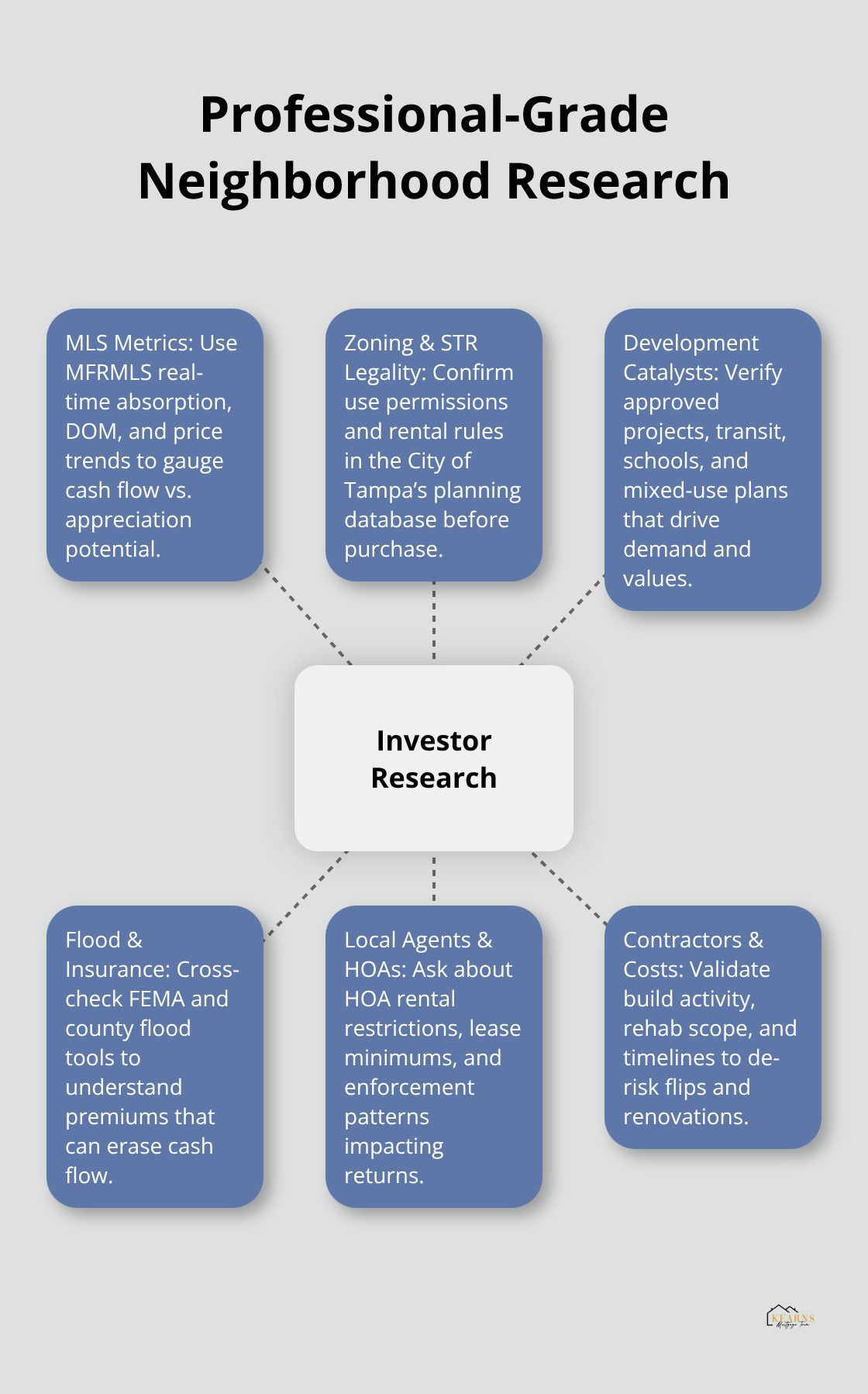
Broad market statistics mask the truth about Tampa Bay real estate. The neighborhoods that work for your strategy require micro-market analysis, and that starts with understanding exactly what data exists and where to find it. MFRMLS, the local multiple listing service, publishes real-time metrics updated through January 24, 2026, showing absorption rates, days-on-market, and price trends broken down by neighborhood and property type. These numbers reveal whether a neighborhood favors cash flow or appreciation.
University Square shows median prices of $299,000 with 45.9% appreciation since 2021 and rents averaging $1,558, which signals a neighborhood transitioning from value play to stabilized rental demand. Channel District commands $3,198 monthly rents but posted only 13.7% appreciation, meaning cash flow investors should prioritize it over equity players. Pull MFRMLS data for your target neighborhoods, then cross-reference flood zones using FEMA maps and Hillsborough County flood tools-properties in flood zones face insurance costs that can eliminate cash flow entirely.
Verify Zoning and Development Catalysts
Verify zoning classifications through the City of Tampa’s planning database to confirm short-term rental legality before purchase. Highland Pines appreciated 44.9% to $282,500 despite reputation challenges, but that upside only matters if you understand what’s driving it: new school expansions, improved infrastructure, or incoming commercial development. Research the City of Tampa’s approved projects and the Police HQ site redevelopment proposal with a February 6, 2026 deadline, as nearby properties benefit from density and mixed-use development.
What’s actually under construction or approved must precede your purchase, not follow it. Properties in redevelopment areas attract new construction when builders replace older homes with new $3–5 million properties, which signals genuine neighborhood momentum rather than speculation.
Tap Local Agent and Contractor Intelligence
Local real estate agents and contractors provide intelligence that data cannot supply. An agent familiar with South Tampa neighborhoods near MacDill Air Force Base understands service member housing stipends and tenant stability in ways MLS data alone cannot communicate. Ask agents specifically about HOA restrictions on rentals, minimum lease terms, and enforcement trends-some associations ban short-term rentals entirely or cap the number allowed annually, which kills deal economics instantly.
Contractors working in redevelopment areas reveal which neighborhoods are attracting new construction and which remain stalled. Redevelopment accelerates when new properties command $3–5 million price points, attracting higher-income buyers who demand upgraded amenities, restaurants, and entertainment. Build relationships with three to five local agents and two contractors before making offers, because zoning compliance, HOA rules, and flood insurance availability determine profitability far more than purchase price.
Structure Your Financing for Multi-Property Growth
Understand your financing options upfront. DSCR financing qualifies based on property income rather than personal finances, which proves essential when managing multiple Tampa Bay properties. Twenty to twenty-five percent down payments on cash-flowing properties with solid credit positioning allows you to deploy capital efficiently across multiple micro-markets rather than concentrating risk in a single neighborhood. This approach lets you execute on multiple micro-market opportunities simultaneously instead of waiting for perfect conditions in one location.
Final Thoughts
Tampa Bay investment properties succeed when you match strategy to neighborhood fundamentals rather than chasing broad market trends. University Square offers appreciation potential at $299,000 with 45.9% growth since 2021, while Channel District delivers cash flow at $3,198 monthly rents, and Highland Pines presents early-stage entry points for investors willing to execute thorough due diligence. Each neighborhood demands different analysis and execution, which is why micro-market research and local expertise separate successful investors from those who follow hype.
Your next step depends on your capital, timeline, and risk tolerance. Appreciation-focused investors must verify what development catalysts actually exist before committing capital to transitional areas, cash flow investors need to confirm short-term rental legality and HOA restrictions through local agents and zoning databases, and fix-and-flip investors must identify neighborhoods where redevelopment is already underway rather than speculative. Structure your financing upfront with DSCR loans that qualify based on property income rather than personal finances, which proves essential when managing multiple Tampa Bay investment properties across different neighborhoods.
We at Kearns Mortgage Team help investors like you navigate financing options that match your growth strategy, whether you pursue conventional financing, explore non-QM solutions, or structure deals across multiple properties. Tampa Bay’s window for strong micro-market deals remains open, but premium prices will follow as neighborhoods showing the strongest fundamentals today attract more capital tomorrow. What neighborhood catalyst matters most to your investment thesis right now?