Getting pre-approved for a mortgage is one of the most important steps in your home-buying journey. It shows sellers you’re serious, gives you a clear budget, and speeds up the entire process when you find the right home.
At Kearns Mortgage Team, we’ve helped thousands of buyers navigate pre-approval with confidence. This guide walks you through exactly what to expect, what documents you’ll need, and how to overcome common roadblocks along the way.
What Pre-Approval Actually Means
Pre-approval is a lender’s conditional commitment to loan you a specific amount of money based on a thorough review of your finances. This isn’t a casual estimate or a rough calculation. A lender will pull your credit report, verify your income with documentation like W-2s and pay stubs from the past two years, review your bank statements covering the last two to three months, and assess your existing debts. According to the Consumer Financial Protection Bureau, pre-approval letter helps you make an offer on a home because it gives the seller confidence that you will be able to get financing to buy the home. The lender isn’t just taking your word for it-they’ve seen your actual numbers. This matters enormously in competitive markets where sellers receive multiple offers.
How Pre-Approval Differs from Pre-Qualification
Pre-qualification is essentially a rough estimate based on information you provide without verification. Pre-qualification takes minutes and requires almost no documentation. Pre-approval takes days or sometimes weeks because it demands proof. The difference is substantial: pre-qualification might tell you that you could afford a $400,000 home based on what you claim to earn. Pre-approval tells you that a lender will actually fund that $400,000 after examining your tax returns, employment history, and liquid assets. One is conversation. The other is commitment.
Why Your Pre-Approval Amount Might Surprise You
The loan size in your pre-approval letter depends on how the lender calculates your debt-to-income ratio. Different lenders can quote vastly different approval amounts for the same borrower because they treat debts, assets, and compensating factors differently. A lender might approve you for $450,000 while another approves you for $380,000. This happens because lenders weigh student loans, car payments, credit card balances, and other obligations in their own way. Some consider your reserves more heavily than others. Some credit compensating factors like an exceptionally high credit score or substantial down payment more generously.
Your debt-to-income ratio is the primary driver: most conventional loans target a ratio around 36% or lower, though some lenders stretch this to 43% depending on your credit profile and reserves. If you earn $6,000 monthly, a 36% ratio means your total monthly debt payments (including the new mortgage) cannot exceed roughly $2,160. This single calculation can shrink your approval amount significantly. The practical takeaway is to ask your lender exactly how they arrived at your specific pre-approval number.

Which debts did they count? Which assets did they value? Understanding these details prevents the shock of discovering that your pre-approval doesn’t stretch as far as you hoped.
How Pre-Approval Transforms Your Home Search
A pre-approval letter fundamentally changes how you search for a home and how sellers perceive you. With pre-approval in hand, you know your actual budget rather than guessing. This eliminates wasted time viewing homes outside your range and prevents the emotional disappointment of falling in love with a house you cannot finance. You can search strategically and make faster decisions.
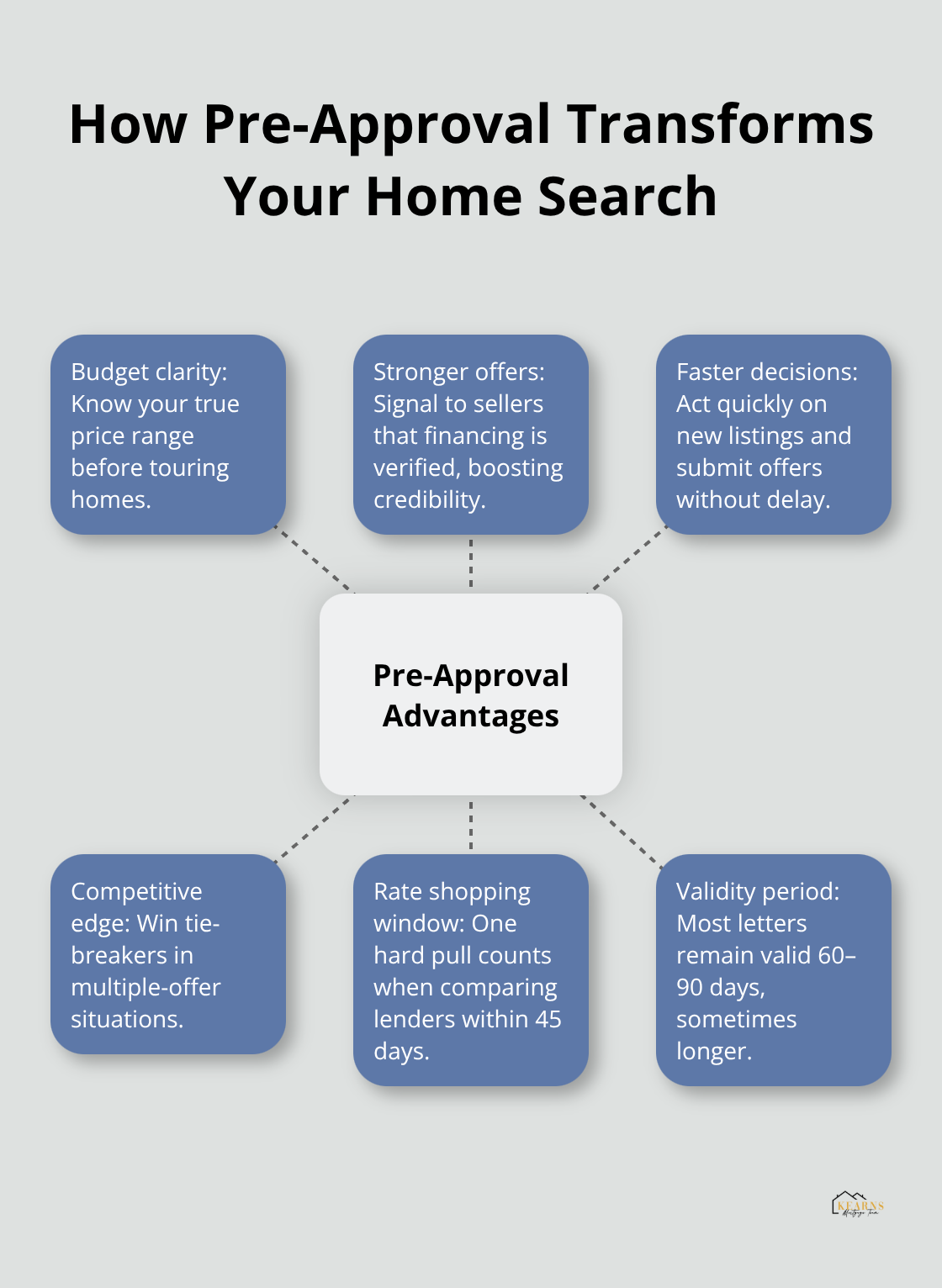
When you find a property, your offer carries credibility immediately. Sellers prefer verified buyers. They’ve seen too many deals collapse because the buyer couldn’t obtain financing. Your pre-approval demonstrates that a bank has already assessed your ability to pay. This becomes especially powerful in markets where homes receive multiple offers within hours. A pre-approval letter often determines which offer wins.
Additionally, the pre-approval process typically remains valid for 60 to 90 days, though some lenders extend this to 120 days or longer. This window gives you time to search without pressure, yet keeps your financial picture fresh enough that the lender’s commitment still holds weight. The pre-approval also locks in your credit inquiry as a single hard pull if you shop around with multiple lenders within a 45-day window. This means comparing rates from three or four lenders barely impacts your credit score, whereas applying sequentially over months would damage it more significantly.
What Happens Next in the Pre-Approval Process
Pre-approval isn’t just paperwork-it’s your permission slip to move forward with confidence. Once you understand what pre-approval means and how it shapes your buying power, the next step involves gathering the specific financial documents your lender will request and moving through the formal application process.
The Pre-Approval Process: Documents, Credit Review, and Your Approval Letter
Gather Your Financial Documents First
Getting pre-approved moves quickly once you submit the right paperwork, but gathering everything upfront prevents delays that can stretch the process from days into weeks. Most lenders need the same core documents, though the specifics vary based on your income type and financial situation.
Start with your tax returns and W-2s from the past two years. These establish your income history and prove you’ve earned what you claim consistently.

Next, gather your most recent 30 days of pay stubs if you’re paid biweekly, or 60 days if you’re paid monthly. Pay stubs show your current income and any deductions.
Then collect two to three months of bank statements from checking, savings, and money market accounts. Lenders examine these to verify you have liquid funds for a down payment and closing costs, and to spot any large deposits that might need explanation. If you’re self-employed, provide year-to-date profit-and-loss statements, accounts receivable details, and possibly 1099s. Self-employed borrowers face stricter scrutiny because income fluctuates more than W-2 earners, so documentation must be exceptionally clear.
If you receive bonuses, disability benefits, alimony, child support, or pension payments, document those too. Lenders will count these only if you can prove a two-year history of receiving them consistently. Include statements for retirement accounts like 401(k)s and IRAs, plus any investment accounts, covering the last two to three months. Finally, bring a government-issued ID, employment contact information for your past two employers, and details about any other real estate you own or any gift funds for your down payment.
How Lenders Assess Your Credit and Financial Health
Once documents arrive, the lender pulls a hard credit inquiry that shows your credit score, payment history, and all existing debts. This single pull barely dents your credit score, typically dropping it by just a few points that recover within weeks. The real impact comes from multiple hard inquiries spread over time, which is why shopping with several lenders within a 45-day window counts as one inquiry according to Freddie Mac guidelines.
The lender then calculates your debt-to-income ratio (DTI) by adding all monthly debt payments including the new mortgage and dividing by your gross monthly income. Conventional loans typically target a DTI around 36 percent or lower, though some lenders approve up to 43 percent if you have strong compensating factors like a high credit score above 760, substantial reserves, or a larger down payment.
Lenders also examine your credit history for late payments, collections, or other red flags. A single missed payment years ago matters less than recent delinquencies. If you spot errors on your credit report before applying, dispute them immediately with the credit bureau. Correcting inaccuracies can raise your score and improve your pre-approval amount. Avoid opening new credit accounts, making large purchases, or closing existing accounts during pre-approval because these actions signal financial instability and can lower your score or reduce your approved amount.
From Application to Pre-Approval Letter
After you submit your documents, most lenders issue a decision within one to three business days, though some promise decisions in as little as one day. The loan officer reviews your entire file, verifies employment by contacting your employer directly or through a third-party service, and confirms income matches what you claimed.
Once approved, you receive a pre-approval letter stating the loan amount, estimated interest rate, and any conditions that must be satisfied before final approval. This letter remains valid for 60 to 90 days for most lenders, giving you time to search without urgency. If your financial situation changes during this window, inform your lender immediately. A job change, new debt, or loss of income can jeopardize your approval.
Keep the letter safe but understand it’s not a final commitment. Final approval depends on the property appraisal confirming the home’s value supports the loan amount, and underwriting verifying that everything still aligns when you actually find a home and make an offer. With your pre-approval letter in hand, you’re ready to move into the next critical phase: identifying and overcoming obstacles that commonly arise during the approval process.
Common Obstacles During Pre-Approval and How to Overcome Them
Credit score problems, high debt payments, and employment verification issues stop pre-approval more often than you’d think. The good news is that most obstacles are fixable if you address them strategically before applying.
Addressing Credit Score Concerns
A credit score below 620 makes conventional lending nearly impossible, but scores in the 640 to 680 range are recoverable with focused effort. If your score sits below 700, dispute any errors on your credit report immediately with the three major bureaus because inaccuracies cost you points you don’t deserve to lose.
Pay down credit card balances aggressively before applying. Lenders calculate your debt-to-income ratio using your full credit limit, not just your current balance, so a card with a $10,000 limit counts as $10,000 in monthly obligations even if you owe only $2,000. Paying that balance down to $2,000 doesn’t help unless you also request the issuer lower your credit limit, which directly reduces the debt lenders attribute to you. This single tactic can swing your approval from denied to accepted.
Avoid opening new accounts or closing old ones during pre-approval because both actions signal financial instability and drop your score further. Each hard inquiry from a new application damages your score, and closing accounts reduces your available credit, which raises your utilization ratio.
Managing Debt-to-Income Ratio Issues
Your debt-to-income ratio becomes the real battleground for most applicants. If lenders calculate your DTI at 45 percent when conventional loans target 36 percent, you’re stuck unless something changes. Attack this aggressively by eliminating smaller debts entirely-paying off a $300 car payment or $200 personal loan removes real monthly obligations and shrinks your ratio immediately.
Some borrowers increase their income on paper by documenting overtime, bonuses, or side income they previously ignored, but this requires a two-year history according to Freddie Mac guidelines, so don’t count on income you just started earning. A larger down payment reduces your loan amount and improves your ratio without touching your existing debts. This approach works especially well if you have access to additional funds.
Handling Employment or Income Verification Problems
Employment verification problems typically arise when you’ve changed jobs recently, are self-employed, or work on commission. If you switched jobs within the past two years, provide documentation from both employers showing you earned similar income, which demonstrates stability to underwriters.
Self-employed applicants need two full years of tax returns plus year-to-date profit-and-loss statements, and lenders will scrutinize these heavily for consistency. Commission-based income requires a two-year average, not just your best year, so honest documentation matters more than inflated numbers.
Contact your employer proactively and ask them to prepare for a verification call from the lender (this speeds the process and prevents delays when the lender reaches out). A simple heads-up to your HR department ensures someone answers the phone when the lender calls, rather than having the request sit unanswered for days.
Final Thoughts
Your pre-approval letter transforms an overwhelming process into a clear, manageable path forward. It tells you exactly what you can afford, eliminates guesswork, and gives you credibility in competitive markets where sellers receive multiple offers within hours. Once you receive it, you can search strategically within your approved amount and make offers with confidence that your financing will hold up.
After your offer is accepted, you’ll officially apply for the loan, pay for the appraisal and credit report, and submit full documentation again. This is when you can shop around for the best mortgage rate and terms by comparing rate sheets from multiple lenders-nothing is final until you sign the initial disclosures, so you have flexibility to switch lenders if another offers better terms. The entire process moves faster when you’ve already completed pre-approval because lenders have verified your finances and employment.
Kearns Mortgage Team guides borrowers through every step of getting pre-approved for a mortgage with personalized solutions and transparent communication. Whether you’re a first-time buyer or refinancing, we offer conventional, VA, FHA, USDA, and non-QM loan options tailored to your situation. What’s your biggest concern about the pre-approval process, and how will you address it before taking your next step toward homeownership?