Tampa’s real estate market is shifting fast, and if you’re thinking about buying or selling here, you need to understand what’s happening right now. We at Kearns Mortgage Team are tracking the Tampa real estate market trends closely to help you make informed decisions.
Population growth, job expansion, and changing interest rates are reshaping neighborhoods and creating both challenges and opportunities. Whether you’re a first-time buyer, an experienced investor, or someone looking to sell, the data tells a clear story about where this market is headed.
Tampa Home Prices and Market Activity in 2025
Where Tampa Home Prices Stand Right Now
Tampa’s median home price hit $447,804 in 2024, representing a roughly 55% jump since 2020 when homes sold for around $288,767. That’s significant appreciation, but the growth trajectory changed shape in 2025. Florida listings rose more than 27% year over year, and the greater Tampa Bay area median price was around $370,000 as of September 2024, reflecting a 2.6% year-over-year decrease. This stabilization matters because it signals the end of the rapid appreciation cycle that defined the previous four years. If you bought in 2020 and held through 2024, you’ve built substantial equity. If you’re buying now, you’re entering a different market where prices aren’t climbing as aggressively, which reduces the risk of overpaying and gives you more room to negotiate.
What the Numbers Tell You About Current Conditions
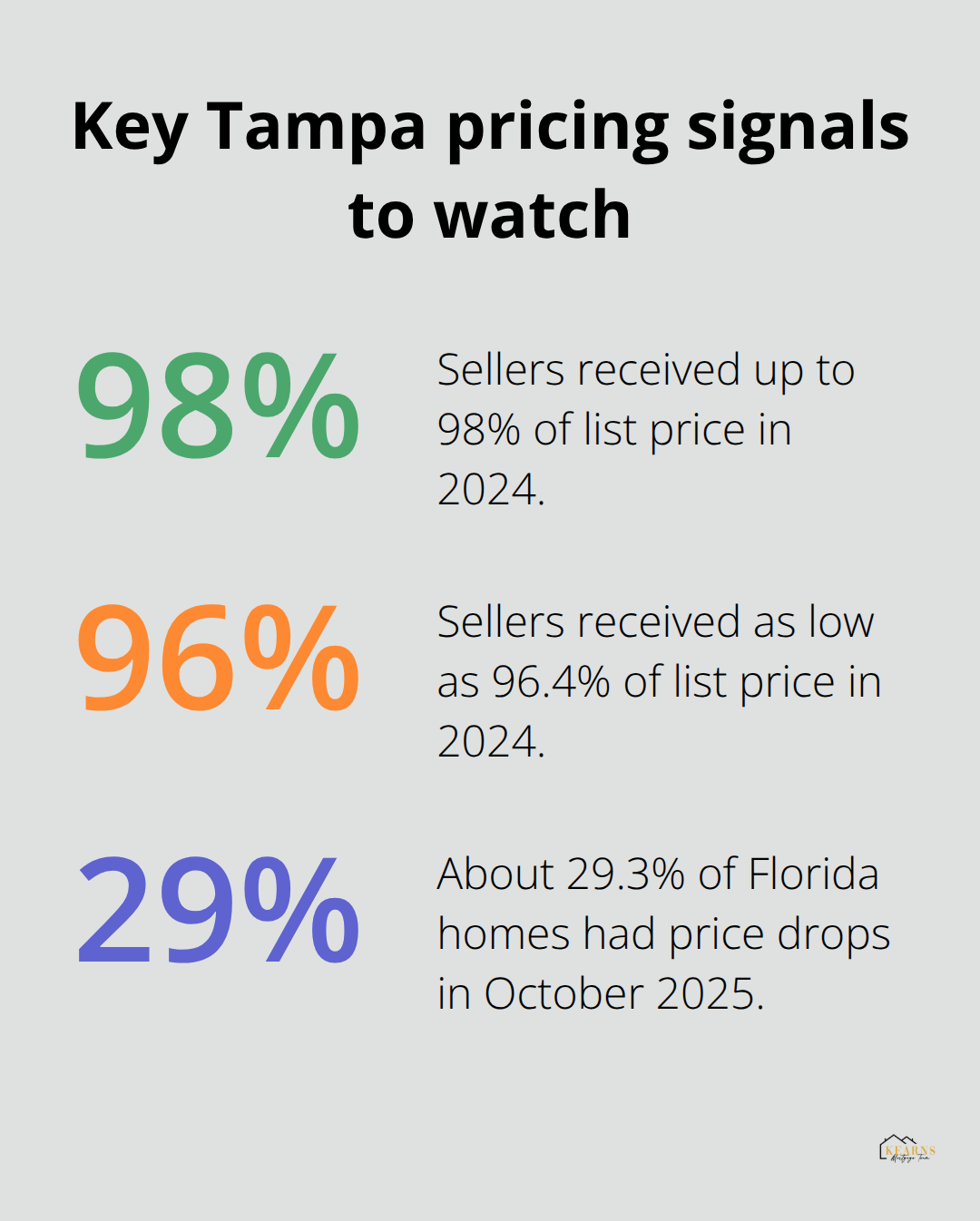
The monthly breakdown from 2024 shows how the market evolved. June peaked at $499,900, but prices settled around $462,000 in December. Sellers received between 96.4% and 98% of list price throughout the year, meaning homes still sold close to asking but without the aggressive bidding wars of 2022 and 2023. Days on market stretched longer as inventory increased, averaging 35 to 50 days depending on the month. This shift favors buyers who now have more choices and less pressure to make emotional decisions. For sellers, accurate pricing based on recent comparable sales in your specific neighborhood is no longer optional-it’s essential. Overpriced homes sit longer, and with roughly 29.3% of Florida homes experiencing price drops in October 2025 according to ATTOM data, aggressive pricing corrections are happening across the state.
Tampa is following that pattern, so pricing strategy matters more than it did two years ago.
Sales Activity and Market Fundamentals
Annual sales dropped 39% from 2021 to 2024, falling from 9,120 to 5,526 closed transactions. That decline reflects higher interest rates and reduced buyer purchasing power, not lack of demand. Tampa Bay ranked as the 4th top market to watch in 2025 by PwC and the Urban Land Institute, driven by job growth and economic momentum. Population in Hillsborough County grew about 5% since 2020 while housing construction lagged behind, creating a persistent shortage. This gap between population growth and housing supply keeps underlying demand strong despite lower sales volume. If you’re planning to sell, expect a longer marketing timeline than you would have experienced in 2023, but the fundamentals supporting demand remain intact. If you’re buying, the increased inventory gives you genuine options, and mortgage rates around 6.22% for a 30-year fixed as of January 2026 reflect where the market has stabilized after the volatility of recent years.
What This Means for Your Next Move
The shift from a seller’s market to a more balanced environment changes how you should approach your transaction. Buyers now have leverage they lacked in 2023, while sellers must compete on presentation and pricing rather than simply listing and waiting. The data shows that homes priced accurately and presented well still move, but homes that miss the mark sit longer and often require price reductions. Understanding these dynamics helps you position yourself for success, whether you’re buying or selling. The next section explores the economic forces that continue to drive demand in Tampa, even as the market cools from its rapid-growth phase.
Why Tampa Keeps Growing Despite Market Shifts
Population Growth Creates Persistent Housing Demand
Hillsborough County added roughly 5% to its population since 2020 while housing construction lagged significantly behind that growth rate, creating a structural shortage that won’t disappear overnight. This mismatch between people moving in and homes available for purchase means demand stays firm regardless of monthly price fluctuations. Tampa Bay ranked as the 4th top market to watch in 2025 according to PwC and the Urban Land Institute, a ranking driven explicitly by job growth projected at 2.3 times the national five-year forecast. That level of employment expansion attracts remote workers, career changers, and families seeking better opportunities, and these newcomers need places to live. If you’re considering Tampa as an investment or a place to relocate, the underlying economic drivers supporting demand are real and measurable, not speculative.
Why Housing Supply Matters More Than You Think
Population inflow combined with constrained housing supply means your property retains value through market cycles because someone will always want to move here for work and lifestyle reasons. The shortage isn’t temporary-it reflects years of construction that failed to keep pace with migration patterns. This structural imbalance protects your investment even when prices stabilize or dip slightly in the short term. Sellers benefit from knowing that demand fundamentals remain strong, while buyers understand that waiting for prices to drop significantly may not be a winning strategy given the supply constraints.
Mortgage Rates and Your Buying Power
Mortgage affordability presents the counterbalance to this demand story, and rate movements directly impact your buying power. As of January 2026, a 30-year fixed mortgage in Florida sits around 6.22% with 15-year options at 5.73%, while Bankrate projects rates could reach 6.5% by year-end, introducing volatility you need to plan for. A stronger credit score above 740 combined with a 20% down payment positions you best to secure favorable terms and avoid private mortgage insurance costs. If your credit sits lower, FHA loans accept scores as low as 580 with just 3.5% down, making homeownership accessible even if your financial profile isn’t perfect.
Loan Options That Fit Different Financial Situations
VA loans offer zero down payment for eligible military members, often without PMI, though a funding fee between 1.25% and 2.15% applies for first-time buyers. Florida Housing Finance Corporation runs first-time buyer programs including Florida Assist and the Florida Homeownership Loan Program, both worth exploring if you qualify. These programs exist specifically to help buyers who don’t fit conventional lending profiles, so investigate whether you meet the eligibility requirements before assuming traditional financing is your only path.
Taking Action on Rates and Terms
Strengthen your credit before rate-shopping, then get preapproved at multiple lenders to compare at least three offers. Lock your rate once you find your home rather than waiting for lower rates that may never materialize. Population and job growth will keep Tampa desirable, but your ability to afford a home depends on understanding your mortgage options and acting decisively when rates and terms align with your financial situation.

The next section examines specific neighborhoods and investment opportunities where these economic forces translate into tangible property value and rental income potential.
Investment Opportunities in Tampa’s Stabilizing Market
Tampa’s stabilizing prices and rising inventory create genuine investment opportunities, but success depends on understanding where demand clusters and which property types generate reliable returns. The luxury market tells the clearest story about investor confidence right now. Record-breaking activity in Tampa Bay’s high-end property sector signals that wealthy buyers remain committed to the market despite broader price moderation. This strength at the luxury tier indicates structural demand from people with the resources to weather market cycles, not speculative investors chasing quick gains.
Where Rental Income Performs Best
For investors targeting rental income, cash-on-cash return matters more than purchase price appreciation. Florida’s median sales price of $410,000 as of August 2025 according to Florida Realtors provides a useful benchmark for mid-market properties where rental demand remains solid. Properties priced between $350,000 and $450,000 in established neighborhoods with job center proximity generate the most consistent tenant interest. Neighborhoods within 15 minutes of downtown Tampa, the airport, or major employment hubs like the Westshore business district command rental premiums that justify the purchase price. A property yielding 6% to 8% annual gross rental income outperforms most alternative investments, and Tampa’s continued job growth keeps tenant demand predictable.
Growth Corridors and Development Zones
Commercial and mixed-use development areas deserve attention because they signal where Tampa directs growth capital. Areas experiencing active redevelopment or zoning changes for higher-density residential use offer appreciation potential as property values follow infrastructure investment. The Ybor City corridor and the Channel District continue attracting mixed-use projects that blend residential, retail, and office space, creating neighborhoods where property values compound as amenities arrive. Local real estate professionals who track development pipelines and zoning decisions provide insights that historical sales data cannot. The gap between housing supply and population growth persists, meaning any property you acquire in an area with job growth and infrastructure development has built-in demand support that reduces vacancy risk.
Financing Investment Properties Strategically
Investment property financing requires different loan structures than owner-occupied homes, with higher down payments and stricter income verification. Get preapproved for an investment loan before making offers, because seller negotiations move faster when you can prove financing capability immediately.
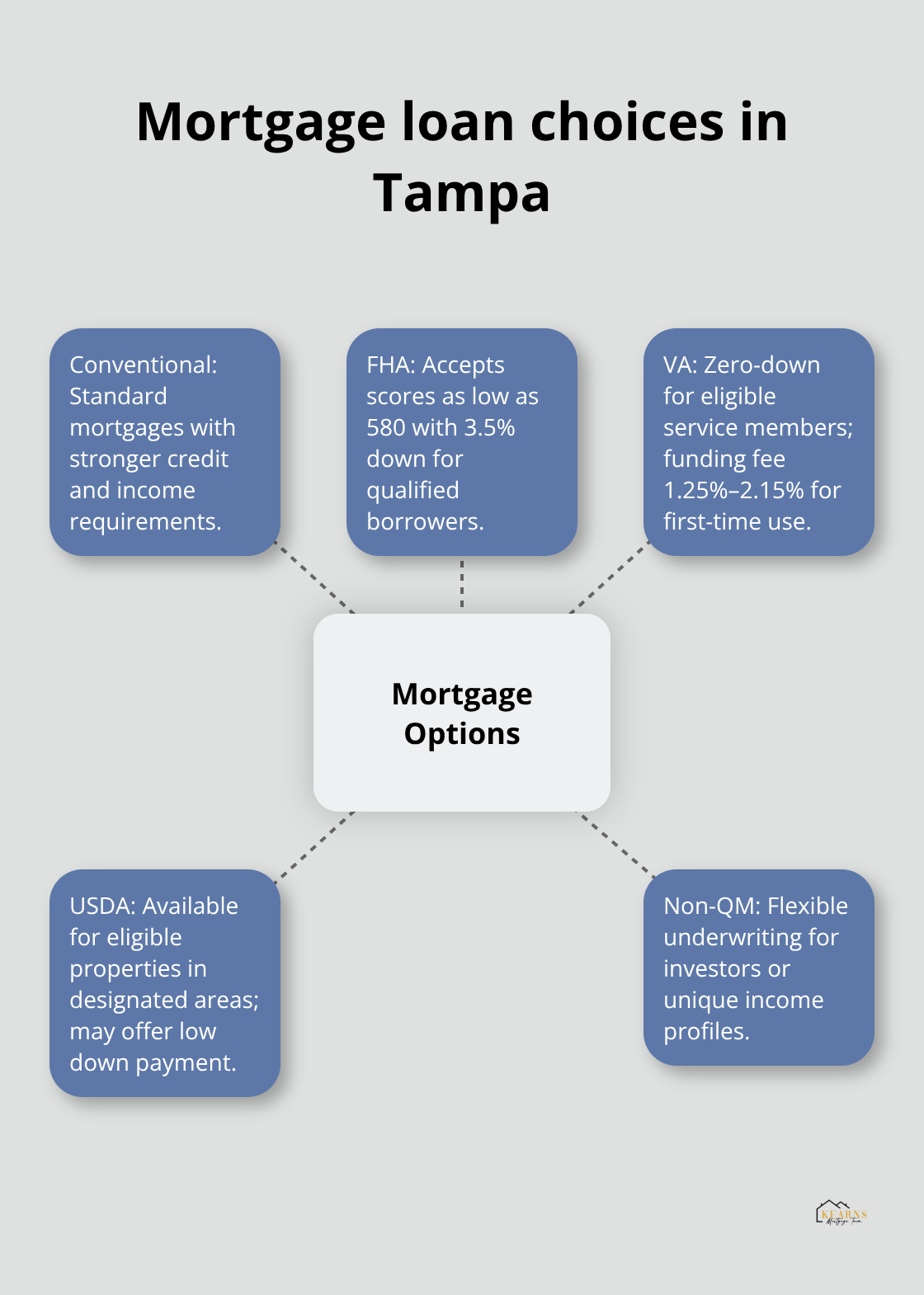
Commercial mortgage loans offer a variety of options, including Conventional, VA, FHA, USDA, and Non-QM solutions, to suit different investment profiles and financial situations. Understanding your financing options before you identify properties positions you to act decisively when the right opportunity appears in your target neighborhood.
Final Thoughts
Tampa’s real estate market has shifted from the rapid-appreciation environment of 2022 and 2023 into a more balanced landscape where strategy matters more than timing. Median prices stabilized around $447,804 in 2024 and have moderated slightly as inventory increased, giving both buyers and sellers clearer ground to stand on. Population growth continues, job expansion outpaces national forecasts, and housing supply still lags behind newcomer arrivals-this combination means Tampa retains genuine long-term appeal despite shorter-term price moderation.
For buyers, the current environment offers real advantages: increased inventory eliminates bidding wars, mortgage rates around 6.22% for a 30-year fixed have stabilized, and you can negotiate from a position of strength. Strengthen your credit, determine your realistic budget, and get preapproved at multiple lenders to compare offers before you start shopping. Understanding your loan options-whether conventional, FHA, VA, or specialized programs-positions you to act decisively when you find the right property.
For sellers, accurate pricing based on recent comparable sales and strong presentation have become non-negotiable in Tampa’s real estate market trends. Homes priced correctly and marketed professionally still move, but overpriced properties now face price reductions and extended market time. We at Kearns Mortgage Team help buyers and sellers navigate financing with personalized mortgage solutions tailored to your specific needs, so contact our team to discuss your Tampa real estate goals.